
In New Zealand’s 2026 rental market, the old days of “buy a property, find a tenant, and sit back collecting rent” are long gone.
The core rule now is simple: compliance is the foundation for protecting long-term returns and avoiding a drop in asset value.
Among all compliance requirements, one policy that many long-time landlords jokingly call “money that breathes” is still catching people out: the Healthy Homes Standards.
Today, from the perspective of frontline property management, let’s have an honest conversation with landlords: why what you think is “probably fine” may look like a list of problems in the eyes of the Tenancy Tribunal.
Stop Taking Chances: The Last “Safe Zone” Is Gone
Over the past few years, many landlords were not in a hurry because the government provided various grace periods, such as meeting the standards within 120 days after signing a new tenancy agreement.
But please update your information: as of now, the final exemption grace period for all private rentals has fully ended.
In other words, if your property is currently being rented out, regardless of when the tenancy agreement was signed, it must meet the Healthy Homes Standards right now, fully and completely.
The real cost:
If a tenant complains or an inspection finds that the property is non-compliant, the Tenancy Tribunal can award exemplary damages of up to $7,200. Even worse, if the required compliance statement is missing from the updated tenancy agreement, you may face a penalty of up to $500 for procedural non-compliance, even if the property itself meets the standards.
That is real money coming straight out of your pocket.

These Five Common Risk Areas: Does Your Property Really Pass?
Many landlords think: “I bought a property built after 2010,” or “I bought a high-end apartment, so I should be safe.”
Not necessarily.
Based on the assessment feedback we see on the ground, even newer properties can fail on these five details.
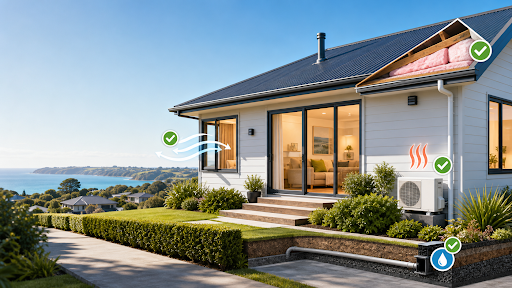
1. Heating: Having an Air Conditioner Is Not Enough
The living room must have a fixed heater, usually a heat pump, and it must be capable of maintaining the living room at 18°C.
Common issue: Many landlords install a small heat pump in a large living room and assume the job is done. However, MBIE uses a detailed kW calculation formula. If there are many windows, high ceilings, or the unit is underpowered, the property may still be non-compliant.
2. Insulation: Older Homes Are Most at Risk
Ceiling and underfloor insulation must meet the required R-value standards. For example, ceiling insulation must generally be at least R2.9 in the North Island and R3.3 in the South Island.
Common issue: Even if insulation was installed more than ten years ago, it may no longer comply if it has slumped, shifted, been compressed, or lost thickness. In that case, it must be topped up or replaced.
3. Ventilation: Recirculating Rangehoods No Longer Cut It
Kitchens and bathrooms must have extractor fans or rangehoods that vent to the outside.
Common issue: In many apartments or townhouses, the kitchen rangehood is a recirculating filter type for aesthetic reasons. It absorbs grease and odour but does not discharge air outdoors. Under the Healthy Homes Standards, that is a fail.
4. Moisture Ingress and Drainage
If the property has a suspended timber floor and an enclosed subfloor space, a polythene vapour barrier of at least 0.25mm thickness must be installed.
Common issue: This is mostly physical work, but landlords are often caught out because the vapour barrier is damaged, does not fully cover the ground, or there is surface water underneath the house.
5. Draught Stopping
Doors and windows must not have obvious gaps or draughts. If the property has an old decorative fireplace that is not in use, it must be completely blocked off.
A Different Way to Think About It: This Is Not an Expense, It Is Asset Appreciation

There is a very good view in the industry: “On the surface, the Healthy Homes Standards look like homework for the government. In reality, they protect your own asset.”
Less maintenance means more profit. Anyone who has lived in New Zealand knows how damp the climate can be. A property with proper moisture control, insulation, and ventilation can significantly extend the lifespan of plasterboard, carpets, and timber structures. Spending one or two thousand dollars now may save you from renovation costs that could reach tens of thousands in the future.
Good homes attract better tenants. Warm, dry, mould-free properties are always in demand. They attract high-quality tenants who are clean, stable, and financially reliable. When tenants live comfortably, they are more likely to stay longer, which naturally reduces your vacancy costs.
Final Thoughts
As a landlord in New Zealand, do not gamble on probability, and do not rely on luck.
If you are unsure whether your property currently meets the latest standards, or if MBIE’s English-language formulas are giving you a headache, it may be worth speaking with us. A professional assessment can help protect your property and give you peace of mind.
Also, make sure you keep all invoices and compliance certificates. Build a strong evidence trail. Only when your defence line is solid can your investment returns land safely in your pocket.